
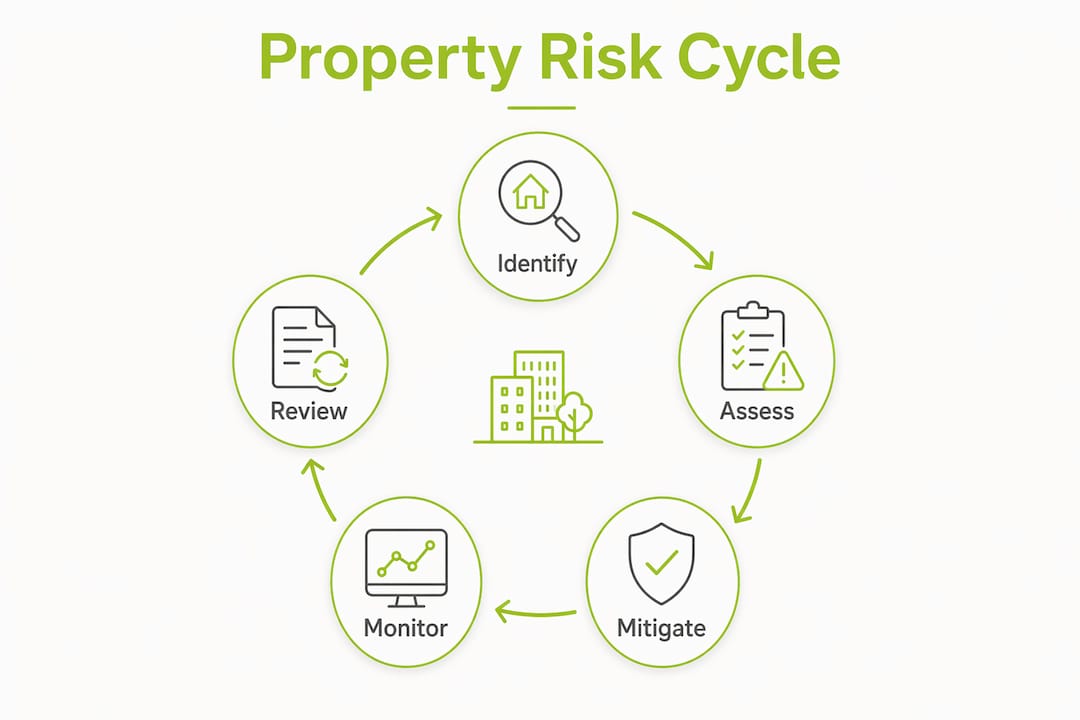
Property risk management is the systematic process of identifying, assessing, mitigating, and monitoring the threats that can erode a property’s financial value, legal standing, or physical safety. For UK property owners, managers, and investors, getting this right is not optional. A single unaddressed risk, whether a fire safety deficiency in a block of flats or a gap in insurance cover during a vacancy period, can trigger regulatory penalties, costly claims, or total loss of rental income. The Orange Book from HM Government sets out the foundational risk management cycle that property professionals in the UK apply: identify, assess, mitigate, and monitor.
Authoritative bodies including the Institute of Real Estate Management (IREM) and the Royal Institution of Chartered Surveyors (RICS) have long championed structured, data-driven approaches over reactive ones. Flatinsurance, as part of the WS Insurance Group and backed by in-house RICS Chartered Surveyors, applies these same principles to help freeholders, RMCs, RTM companies, and portfolio landlords protect their assets.
Core concepts at a glance:
- Property risk management covers physical, environmental, legal, financial, and operational exposures
- The four-stage cycle is: identification, assessment, mitigation, and monitoring
- Insurance transfers financial risk but does not prevent it
- Vacant properties carry specific coverage restrictions that require specialist policies
- RICS technical due diligence and IREM audit protocols provide the professional framework for structured risk management
What are the core categories of property risks in the UK?
UK property risks fall into five distinct pillars, and understanding each one separately prevents the common mistake of treating “insurance” as a catch-all solution.
Physical risks cover the structural and mechanical condition of a building. These are the most visible and often the most expensive to ignore.
- Structural defects: subsidence, roof failure, or deteriorating cladding
- Fire hazards: inadequate compartmentation, missing sprinkler systems, or blocked escape routes
- Mechanical failure: ageing boilers, outdated electrical wiring, or failing lift systems
- Deferred maintenance: small defects that compound into major capital expenditure
Environmental risks relate to the property’s location and its exposure to natural or man-made hazards.
- Flood risk: properties in Environment Agency Flood Zone 2 or 3 face higher premiums and potential uninsurability
- Subsidence from clay soils, particularly across London and the South East
- Contaminated land from prior industrial use, which can affect both value and mortgageability
- Extreme weather events, including wind damage and freeze-thaw cycles affecting flat roofs
Legal and leasehold risks are particularly acute in the UK’s complex leasehold system.
- Non-compliance with fire safety legislation under the Regulatory Reform (Fire Safety) Order 2005
- Lease enforcement failures, such as uncollected service charges or unenforced repair obligations
- Title defects, undisclosed easements, or planning breaches that restrict use or sale
- Breaches of statutory obligations under the Building Safety Act 2022
Financial risks affect the income and capital value of the asset.
- Rent arrears and prolonged void periods reducing net operating income
- Underinsurance, where the declared rebuild value falls short of actual reinstatement cost
- Market fluctuations affecting capital value and refinancing options
- Unexpected capital expenditure from deferred maintenance or regulatory upgrades
Operational risks cover the day-to-day management of a property and its occupants.
- Tenant disputes and reputational damage from poor management
- Contractor negligence or inadequate supervision of works
- Data protection failures in managing tenant records
- Inadequate health and safety procedures for communal areas
Overlaps between categories are common. A fire safety breach is simultaneously a physical risk, a legal risk, and a financial risk if it triggers enforcement action or voids insurance cover.
How do you identify and assess property risks effectively?
The risk management cycle has four stages. Identification and assessment come first, and skipping either one means the mitigation work that follows is built on guesswork.

IREM’s professional framework stresses that you cannot manage what you do not measure. That principle drives the structured audit approach that credentialed property managers apply across their portfolios.
Risk identification methods:
- Hazard audits: a physical walkthrough of the property recording every observable defect, safety concern, or compliance gap
- Technical due diligence carried out by an RICS-regulated surveyor, which goes beyond a standard survey to uncover hidden structural issues, non-compliant fire compartmentation, and inaccurate insurance declaration values
- Lease and document review: checking service charge accounts, maintenance logs, and compliance certificates for gaps
- Tenant and occupier interviews: identifying operational issues that do not appear in paperwork
RICS technical due diligence is particularly valuable because it surfaces defects that routine inspections miss, including non-compliance with Building Regulations, outdated fire compartmentation, and declared rebuild values that bear no relation to actual reinstatement costs.
Risk assessment techniques:
Once risks are identified, each one needs to be scored by likelihood and impact. A data-driven scoring approach combines hazard inventories with probability and severity ratings, producing a prioritised risk register that tells you where to act first.
The COPE framework, standing for Construction, Occupancy, Protection, and Exposure, is the standard tool insurers use to price risk and that investors use to evaluate assets:
- Construction: building materials, age of major components, roof condition, electrical and plumbing systems
- Occupancy: how the building is used, tenant profile, turnover patterns, and liability exposure
- Protection: fire suppression systems, security measures, drainage maintenance, and documented inspection records
- Exposure: flood zone classification, proximity to hazards, and local infrastructure risks
A risk register captures each identified risk, its likelihood and impact score, the current controls in place, and the residual risk after those controls are applied. Reviewing this register quarterly, rather than annually, keeps the assessment current as conditions change.
Pro Tip: When commissioning a technical due diligence report through an RICS-regulated firm, ask specifically for a rebuild cost assessment alongside the condition report. Many blocks carry inaccurate declared values, and the gap between the declared sum and the actual reinstatement cost is one of the most common and costly risks in block of flats insurance.
Practical strategies for mitigating property risks in the UK
Mitigation is where risk management moves from analysis to action. The four standard options, sometimes called the 4 Ts, apply across every risk category.
Treat (reduce): Take direct action to lower the likelihood or impact of a risk. This is the most active form of mitigation.
- Upgrade fire safety: install or upgrade sprinkler systems, replace non-compliant cladding, and commission annual fire risk assessments as required under UK fire safety law
- Improve flood resilience: fit flood barriers, raise electrical installations above predicted flood levels, and clear drainage systems before winter
- Strengthen tenant screening: use consistent, documented criteria to reduce arrears risk and tenancy disputes
- Carry out planned preventative maintenance to address defects before they become claims
Transfer: Shift the financial consequence of a risk to a third party, typically through insurance or contractual indemnities.
- Buildings insurance transfers the cost of physical damage to the insurer
- Property owners liability insurance transfers the cost of third-party injury or damage claims
- Contractor indemnity clauses transfer liability for works-related damage back to the contractor
- Service charge provisions in leases can transfer repair obligations to leaseholders
Insurance is a transfer mechanism, not a prevention tool. A policy that pays out after a flood does not stop the flood from happening or reduce the disruption to tenants. Proactive physical mitigation reduces claim frequency, which in turn protects your premium rating over time.
Terminate (avoid): Remove the activity or condition that creates the risk entirely. This might mean declining to acquire a property in a high flood-risk zone, or choosing not to let to a particular occupier type that creates disproportionate liability exposure.

Tolerate (accept): Retain the risk within a defined financial tolerance. Low-likelihood, low-impact risks that would cost more to mitigate than they are worth to address fall into this category. The key is making that decision consciously, not by default.
Practical mitigation steps for UK property owners:
- Commission annual fire risk assessments and act on every recommendation within the specified timeframe
- Review insurance cover at every renewal, not just on price but on adequacy of declared values
- Maintain a documented maintenance log as evidence of proactive management
- Use technology: remote monitoring systems for water leak detection, fire alarm connectivity, and access control reduce both risk and response times
- Engage a specialist broker with expertise in your property type, whether that is a block of flats, a mixed-use building, or a portfolio of buy-to-let properties
Pro Tip: Specialist brokers with sector-specific knowledge, such as those focused exclusively on residential blocks, can identify coverage gaps that a general broker may miss. Flatinsurance works with RICS Chartered Surveyors in-house to align rebuild cost assessments with policy declarations, reducing the underinsurance risk that affects a large proportion of UK blocks. You can also explore specialist insurance services for additional risk advisory perspectives.
Vacant properties: the insurance risks UK owners often overlook
Vacant properties carry a risk profile that is fundamentally different from occupied ones, and most standard UK insurance policies are not designed to cover them beyond a short period.
Standard buildings insurance and landlord policies typically include a vacancy clause. Once a property has been unoccupied beyond a specified period, cover for certain perils may be restricted or voided entirely. Theft and vandalism are the most frequently excluded risks, but some policies also limit cover for escape of water or malicious damage during vacancy.
The practical consequences are serious. An unoccupied block that suffers a burst pipe in january may find its insurer declining the claim if the property has been vacant beyond the policy’s threshold. Without an active tenancy or regular inspections, the damage can go undetected for weeks, compounding the loss.
Risks that escalate during vacancy:
- Vandalism and break-ins, with no occupants present to deter or report incidents
- Undetected water leaks causing progressive structural damage
- Squatting, which creates both legal and physical risks
- Deterioration from lack of heating, ventilation, and routine maintenance
- Arson, which is disproportionately associated with vacant buildings
Maintaining protection during vacancy periods:
- Notify your insurer immediately when a property becomes vacant, rather than waiting until renewal
- Obtain a vacancy endorsement or switch to a specialist vacant property policy before the standard clause is triggered
- Arrange regular inspections, typically weekly or fortnightly, and document each visit with dated photographs
- Maintain heating at a minimum temperature during cold months to prevent freeze damage
- Secure all access points and consider temporary security measures such as boarding or monitored alarms
- Keep the property’s exterior maintained to reduce its profile as an obvious target
Specialist vacant building insurance requires different underwriting from standard cover, and the terms can vary considerably between insurers. Engaging a broker who understands this market, rather than assuming your existing policy extends to vacancy, is the most direct way to avoid a coverage gap at the worst possible moment. Flatinsurance’s guidance on freehold block underinsurance covers the related risk of declared values falling short during precisely these periods.
Why proactive risk management pays off, and where it gets difficult
The financial case for proactive risk management is straightforward. Identifying and addressing a defect before it becomes a claim costs a fraction of the claim itself, and it protects the premium rating that determines what you pay at renewal. Properties with documented maintenance histories, current fire risk assessments, and accurate rebuild cost declarations consistently attract better terms from insurers than those without.
Beyond cost, proactive management protects legal compliance. The Building Safety Act 2022 introduced new obligations for higher-risk buildings, including mandatory registration and a duty to maintain a safety case. Failure to comply carries criminal penalties, not just civil liability. RICS and IREM both emphasise that structured, documented risk management is the only defensible position when regulatory scrutiny increases.
The challenges are real, though. Smaller landlords and RMCs often lack the internal resource to run a formal risk management programme. Competing priorities, budget constraints, and the complexity of leasehold law all create friction. The most common failure mode is not ignorance of the risks but inconsistency: a fire risk assessment commissioned once and never reviewed, or an insurance policy renewed on autopilot without checking whether the declared rebuild value still reflects current construction costs.
Technology is closing some of these gaps. Remote monitoring systems for water, fire, and access control generate real-time data that replaces the need for constant physical presence. Data analytics tools allow portfolio landlords to track maintenance cycles, compliance deadlines, and insurance renewal dates across multiple properties from a single dashboard.
Who is responsible for managing property risks?
In UK property, responsibility for risk management is rarely held by one party alone. It is distributed across owners, managers, and tenants, and the lease is the document that defines the boundaries.
Freeholders and property owners carry the primary duty to maintain the structure, common parts, and building services. They are responsible for placing adequate buildings insurance, commissioning statutory inspections, and ensuring the property meets fire safety and building regulations requirements. In a block of flats, the freeholder or their appointed managing agent typically holds the insurance policy and manages the service charge fund from which risk-related expenditure is drawn.
Residential Management Companies (RMCs) and RTM companies take on the freeholder’s management obligations when leaseholders exercise their right to manage. Directors of RMCs carry personal liability for decisions made in that capacity, which is why directors’ and officers’ liability insurance sits alongside buildings cover as a standard part of a well-structured block of flats insurance programme.
Managing agents act on behalf of owners or RMCs and carry professional liability for the advice and services they provide. Their responsibilities typically include arranging insurance, managing contractors, maintaining compliance records, and responding to maintenance requests. Errors and omissions in any of these areas create direct financial exposure for the agent and, ultimately, for the property owner who appointed them.
Tenants and leaseholders hold obligations defined by their lease, which may include maintaining their own demise, reporting defects promptly, and not carrying out alterations without consent. In practice, tenant behaviour is one of the harder risks to control. Clear lease drafting, consistent enforcement, and good communication reduce the likelihood of disputes escalating into claims.
The most effective risk management happens when all three groups understand their respective obligations and communicate regularly. An annual building inspection shared with leaseholders, a clear process for reporting maintenance issues, and transparent service charge accounts all reduce the information gaps that allow risks to go unaddressed.
Key takeaways
Effective property risk management in the UK requires a structured, documented cycle of identification, assessment, mitigation, and monitoring, applied consistently across all five risk categories.
| Point | Details |
|---|---|
| Five risk pillars | Physical, environmental, legal, financial, and operational risks each require distinct management approaches. |
| COPE and risk registers | Use COPE analysis and scored risk registers to prioritise threats by likelihood and impact before acting. |
| Insurance transfers, not prevents | Insurance shifts financial exposure but does not reduce the frequency or severity of incidents. |
| Vacancy clauses are a real gap | Standard policies may void cover for theft and vandalism after a specified vacancy period; specialist cover is needed. |
| Responsibility is shared | Owners, managing agents, RMCs, and tenants each hold defined obligations; the lease sets the boundaries. |