
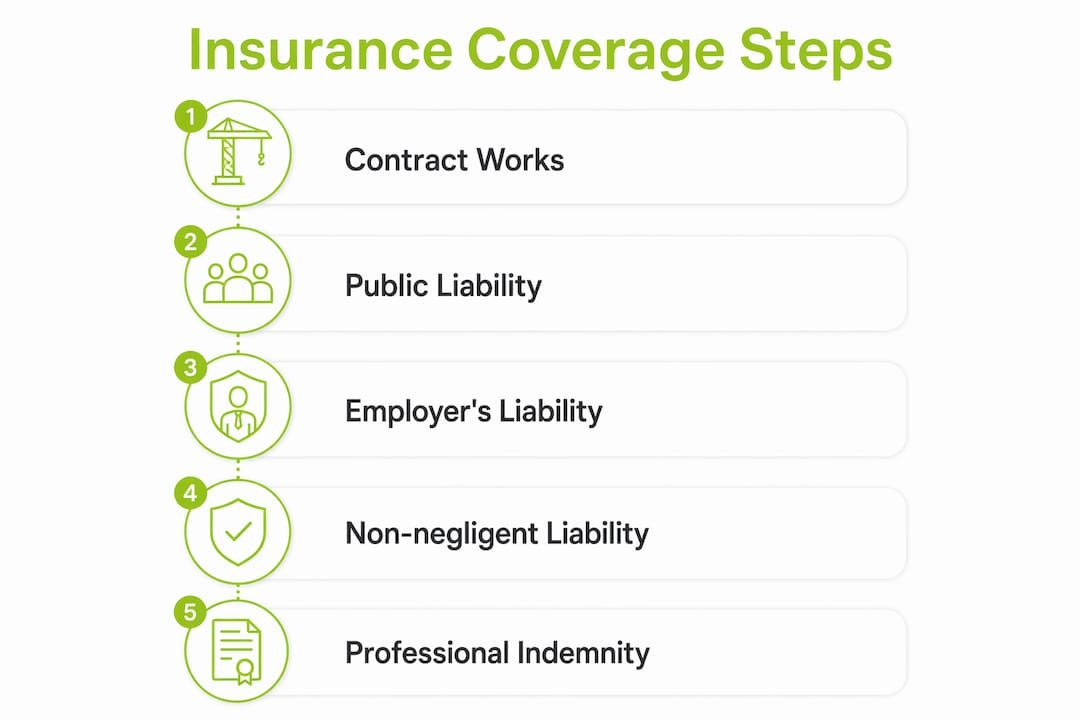
Protecting flats during construction or refurbishment requires at least four distinct insurance policies working in parallel: contract works (also called contractors’ all risks), public liability, employer’s liability, and non-negligent liability under JCT clause 6.5.1. Professional indemnity insurance is also necessary wherever the developer holds any design responsibility. Getting this combination right before a single spade hits the ground is crucial to managing potential claims efficiently and avoiding overwhelming financial exposure.
The core policies you need to have in place:
-
Contract works insurance covers physical loss or damage to the works themselves, including fire, flood, theft, and accidental damage at every stage of the build
-
Public liability insurance protects against third-party injury and property damage claims arising from site activity; standard minimum coverage runs from £1m to £5m depending on project scale; the minimum required by lenders is £5m, and larger schemes may require £10m
-
Employer’s liability insurance is a legal requirement under the Employers’ Liability (Compulsory Insurance) Act 1969 if you directly employ anyone on site, with a statutory minimum of £10m
-
Non-negligent liability insurance (JCT clause 6.5.1) covers structural damage to neighbouring properties where no contractor negligence can be proved, a critical gap in standard public liability cover
-
Professional indemnity insurance applies where the developer takes on any design, specification, or advisory role
-
Structural warranty (such as NHBC or LABC Warranty) is required by most lenders for new-build residential schemes and by mortgage lenders on the completed units
A brief note on terminology: the industry term for the overarching policy covering physical damage to the works is “contractors’ all risks” or “contract works insurance.” The phrase “construction property insurance” is sometimes used informally to describe the same cover, but the standard contract and lender documentation will always refer to contract works or contractors’ all risks.
What does insurance for flats under construction actually cover?

Contract works insurance
Contract works insurance is the foundation of any construction phase insurance programme. It covers the full reinstatement value of the works in progress against insured perils including fire, storm, flood, theft, vandalism, and accidental damage. The policy must also cover any existing structures on the site, temporary buildings, plant, and materials awaiting installation.

Underinsurance is a persistent problem on development projects because the value of the works increases continuously as construction progresses. If the sum insured reflects only the initial build cost and ignores variations or cost escalation, you may be significantly underinsured precisely when a major claim is most likely. Lenders require the sum insured to reflect the full reinstatement value at completion, plus demolition and debris removal costs.
For a standard residential development with a build cost of £1.5m, contract works premiums typically run between £3,000 and £6,000. Larger schemes with build costs above £5m attract premiums of £10,000 to £20,000. Timber frame construction commands higher premiums than traditional masonry because of the elevated fire risk during the build phase.
Pro Tip: Review your sum insured at each practical stage of the build, not just at inception. A policy set at ground-floor slab level will be materially inadequate by the time the roof goes on.
Public liability insurance
Public liability cover responds to claims from third parties who suffer injury or property damage as a result of construction activity. This includes neighbours, members of the public, and visitors to the site. While public liability is not a legal requirement for UK contractors, it is contractually required by clients and by every development finance lender. Most lenders insist on substantial public liability coverage, especially for larger or more complex schemes.
One point developers frequently miss: the contractor’s public liability policy covers the contractor’s liabilities, not yours. If a member of the public is injured because of inadequate site security that was your responsibility, the contractor’s insurer will not respond. You need your own policy, and the lender will require evidence of both.
Employer’s liability insurance
If you directly employ anyone involved in the project, whether a site manager, labourer, or administrative staff member, employer’s liability insurance is a legal obligation. The statutory minimum is £10m. Where a main contractor employs all site workers directly, their own employer’s liability policy covers those employees. You still need your own cover for any direct employees.
Non-negligent liability insurance under JCT clause 6.5.1
This is the cover that catches most developers off guard. Standard public liability insurance only pays out when negligence can be proved against the contractor. Non-negligent liability insurance under JCT clause 6.5.1 fills the gap where damage to a neighbouring property occurs even though the contractor followed every safety protocol correctly. A single subsidence claim or collapsed party wall can easily reach six figures.
The cover is particularly critical for high-risk activities such as basement excavations, party wall works, demolition involving heavy machinery, and piling operations affecting adjacent buildings’ foundations.
Contractors typically handle the administrative side by adding this cover as an extension to their liability suite, but the cost is passed to the employer as a specific contract expense. Failing to arrange this cover properly can lead to a breach of contract, leaving the employer personally liable for any no-fault damage. Always verify that the certificate is active before works begin. Most project-specific policies include a 12-month discovery period after practical completion, which matters because structural shifts caused by vibration or groundwater changes can take months to appear.
Professional indemnity insurance
Where a developer takes on design responsibility, whether directly or by appointing design-and-build contractors, professional indemnity insurance covers claims arising from errors or omissions in that design. Most lenders require design professionals to carry professional indemnity insurance at adequate levels appropriate to the project size. The Building Safety Act 2022 extended the limitation period for certain residential defect claims to 30 years, which has materially hardened the PI market for residential work. Developers should verify that their appointed professionals carry adequate, current cover and that the retroactive date on their policies covers the full project history.
Additional specialist covers
Beyond the core policies, certain projects require further cover:
- Delay in start-up (also called advanced loss of profit or rent): protects against revenue loss when a project is delayed due to an insured damage event
- Environmental liability: increasingly required for brownfield or formerly industrial sites
- Terrorism cover: relevant for urban developments in higher-risk locations
- Existing structures cover: where works are carried out on or adjacent to a building already in use
Consolidating contract works, liability, professional indemnity, and project property risks into a single programme prevents the coverage gaps that emerge when policies are placed separately with different insurers. Composite policies also tend to be cheaper than buying each cover individually, and they simplify administration considerably.
How development finance lenders shape your insurance requirements
Development finance lenders treat insurance as a condition of lending, not an optional extra. Failure to maintain the required cover is typically an event of default under the finance agreement, which can trigger default interest, penalties, or loan acceleration. The lender’s interest must be noted on every policy.
The standard lender insurance checklist for a residential flat development includes:
- Contract works insurance covering the full reinstatement value throughout the facility term, with the lender noted as an interested party
- Public liability insurance at a minimum of £5m (often £10m for larger schemes)
- Employer’s liability insurance at the statutory minimum of £10m
- Professional indemnity insurance for all design professionals, verified by the developer
- Structural warranty from an approved provider such as NHBC or LABC Warranty
Insurance costs are a genuine development cost that must appear in your appraisal. The total insurance cost for a typical residential construction project ranges from £5,000 to £25,000 depending on size, location, and cover level. These figures sit on top of whatever insurance the contractor carries under their own policies.
A common and costly mistake is assuming the contractor’s policies satisfy the lender’s requirements. They do not. The contractor’s contract works policy may cover the works themselves, but it will not include the lender’s interest notation, and it will not cover the developer’s own liability exposures. Before drawdown, review the interaction between your policies and the contractor’s to avoid paying for duplicate cover or, worse, discovering a gap mid-project. A thorough pre-drawdown review can save between £2,000 and £5,000 in unnecessary premiums.
Pro Tip: Ask your broker to produce a single insurance schedule showing every policy, the insured party, the sum insured, and the lender notation. Send it to your solicitor and lender simultaneously to avoid delays at drawdown.
For developers managing multiple flats under one policy or a portfolio of sites, an annual programme arranged by a specialist broker can be more cost-effective than project-by-project placements, provided each site’s specific risks are properly reflected in the schedule.
How to manage insurance throughout the construction or refurbishment lifecycle
Notify your insurer before works begin
Any material change to a property must be notified to the insurer promptly. Starting construction or refurbishment without notification can void existing cover entirely. For flats already insured under a block of flats buildings policy, the insurer needs to know the nature and value of the works, the contractor’s details, and the expected programme duration.
Keep sums insured current
The sum insured under a contract works policy must track the value of the works at every stage. Set a calendar reminder to review the figure at each practical milestone: foundations complete, superstructure complete, weathertight, first fix, second fix. If a major variation is instructed, notify the insurer immediately rather than waiting for the next renewal.
Coordinate between multiple parties
On a typical flat development, you may have the developer’s own policies, the main contractor’s policies, and separate policies held by specialist subcontractors. The risks of overlap and gap are real. Designate one person, usually the project manager or the specialist broker, to maintain a master insurance register showing every active policy, its scope, its expiry date, and the parties covered.
Common construction risks and how insurance responds
The most frequent claims on flat construction projects involve:
- Fire during the build phase, particularly on timber frame schemes
- Water ingress before the building is weathertight
- Theft of materials and plant from site
- Accidental damage to neighbouring properties during excavation or demolition
- Injury to site visitors or members of the public
Contract works insurance responds to the first three. Public liability and, where relevant, JCT 6.5.1 non-negligent liability cover respond to the fourth and fifth.
Construction delays and their insurance implications
A delay that pushes completion beyond the policy expiry date requires a mid-term extension. Failing to extend cover leaves the works uninsured for the period of overrun. Where a delay in start-up policy is in place, the trigger is typically physical damage causing the delay, not programme slippage alone. Check the policy wording carefully before assuming delay cover is active.
Warranties, guarantees, and their interaction with insurance
A structural warranty such as NHBC Buildmark or LABC Warranty runs for ten years from practical completion and covers defects in the structure. It is not a substitute for contract works insurance during the build. The two products serve different purposes: contract works covers accidental damage during construction; the structural warranty covers latent defects discovered after handover. Both are required by lenders, and both are required by the eventual purchasers’ mortgage lenders.
Legal and regulatory obligations
Under the Employers’ Liability (Compulsory Insurance) Act 1969, employer’s liability insurance is a statutory requirement for any employer. The Health and Safety at Work etc. Act 1974 and the Construction (Design and Management) Regulations 2015 impose duties on developers as clients, including ensuring that contractors have adequate insurance in place. The Building Safety Act 2022 has extended limitation periods for residential defect claims, which has direct implications for how long professional indemnity cover needs to remain active after project completion.
Documentation and record-keeping
Keep copies of every insurance certificate, every policy schedule, and every correspondence with insurers in a single project file. Photograph the site at regular intervals. If a claim arises, contemporaneous records of site condition, contractor activity, and weather events are the difference between a straightforward settlement and a protracted dispute.
Why specialist advice from Flatinsurance makes the difference
Getting the insurance right on a flat development is genuinely complex. The interaction between contract works, liability, professional indemnity, structural warranties, and lender requirements creates multiple points where gaps can emerge, and the consequences of a gap are rarely small.
Flatinsurance, part of the WS Insurance Group, focuses exclusively on residential blocks and flat developments. That specialism matters because a generalist broker placing construction cover with a standard commercial insurer will often produce policies with restrictive terms, inadequate limits, or exclusions that only become visible at the point of claim.
Accurate rebuild cost valuations for blocks of converted flats require professional surveyor assessments rather than generic multipliers. Simple multiplication of individual flat values consistently underestimates the true reinstatement cost, leaving freeholders and developers exposed to costly underinsurance at the worst possible moment.
Flatinsurance’s in-house RICS Chartered Surveyors provide professional rebuild cost assessments as part of the service. For insuring converted house flats in particular, where the Association of British Insurers’ standard rebuilding cost guide explicitly states it should not be used for blocks of flats, a surveyor-led valuation is the only reliable method. Shared valuation costs between leaseholders make this both practical and fair.
The pitfalls Flatinsurance sees most often on construction and refurbishment projects:
- Underinsurance on contract works: sum insured set at inception and never reviewed as the build value grows
- Missing lender notation: policies placed without the lender’s interest noted, triggering a technical default
- JCT 6.5.1 overlooked: developers relying on the contractor’s public liability policy and discovering the negligence gap only when a neighbour makes a claim
- PI gaps on design-and-build contracts: developers signing fitness-for-purpose obligations that their appointed professionals’ PI policies will not cover
- Structural warranty delayed: warranty not arranged until late in the programme, causing exit delays when purchasers’ mortgage lenders require it before exchange
Pro Tip: For urban flat developments involving any excavation, party wall works, or underpinning, treat JCT 6.5.1 non-negligent liability insurance as mandatory rather than optional. The cost is modest relative to the exposure, and lenders and professional advisers will increasingly insist on it regardless.
Key takeaways
Insuring flats under construction requires a coordinated programme of contract works, liability, professional indemnity, and structural warranty cover, with every policy correctly noted in favour of the development finance lender.
| Point | Details |
|---|---|
| Contract works sum insured | Must reflect full reinstatement value at every build stage, including demolition and debris removal costs. |
| Lender insurance obligations | Failure to maintain required cover is typically an event of default, triggering penalties or loan acceleration. |
| JCT 6.5.1 non-negligent liability | Covers no-fault structural damage to neighbouring properties; standard public liability does not fill this gap. |
| Professional rebuild valuations | Generic multipliers undervalue blocks of flats; only a RICS-assessed valuation reliably prevents underinsurance. |
| Construction cost range | Total insurance for a typical residential project runs from £5,000 to £25,000 depending on size and cover level. |
Get specialist cover for your flat development

Whether you are breaking ground on a new build scheme, converting a house into flats, or managing a refurbishment on an occupied block, Flatinsurance can structure a policy programme that satisfies your lender, protects your investment, and closes the gaps that standard policies leave open.
As part of the WS Insurance Group, with in-house RICS Chartered Surveyors and a sole focus on residential blocks, Flatinsurance brings a depth of specialism that a generalist broker simply cannot match. Get a specialist block of flats quote today and speak directly with an adviser who understands the construction phase risks specific to flat developments.