
Freehold block underinsurance occurs when a property’s insured sum falls below its true rebuilding cost, leaving owners exposed to reduced claim payments and significant financial loss. This is not a niche concern. A BCH study found that 60% of buildings were underinsured before a professional appraisal, with 90% carrying inaccurate declared values overall. For freeholders, residential management companies (RMCs), and managing agents, freehold block underinsurance risks translate directly into claim shortfalls, leaseholder disputes, and potential legal liability. Understanding the mechanics behind underinsurance, and how to prevent it, is the most effective way to protect your asset and your obligations under the lease.
Why do freehold block underinsurance risks start with reinstatement cost?
The single most common cause of underinsurance in freehold blocks is confusing reinstatement cost with market value. These are fundamentally different figures, and mixing them up creates a gap that insurers will not fill at claim time.
Market value is what a buyer would pay for the property on the open market. Reinstatement cost is what it would actually cost to demolish the existing structure and rebuild it from scratch to current building regulations. The reinstatement figure includes:
- Demolition and site clearance costs
- Professional fees: architects, structural engineers, and project managers
- VAT on labour and materials
- Regulatory compliance costs, including fire safety and accessibility upgrades required under current legislation
A block worth £800,000 on the market might cost £1.4 million to fully reinstate. The primary cause of underinsurance is precisely this reliance on market value rather than a professionally assessed reinstatement figure. Freeholders who set their sum insured based on a purchase price or estate agent valuation are almost always underinsured from day one.
Construction costs have also risen sharply in recent years due to material prices, labour shortages, and supply chain disruption. A declared value that was accurate three years ago may now be materially insufficient. This is not a theoretical risk. It is a structural feature of the current construction market.

Pro Tip: Never use the mortgage valuation or the purchase price as the basis for your buildings sum insured. These figures serve a different purpose and will almost always understate the true reinstatement cost.
How does the average clause reduce your claim payout?
The average clause is the mechanism insurers use to penalise underinsurance at claim time. Its effect is proportional and applies to every claim, not just total losses.
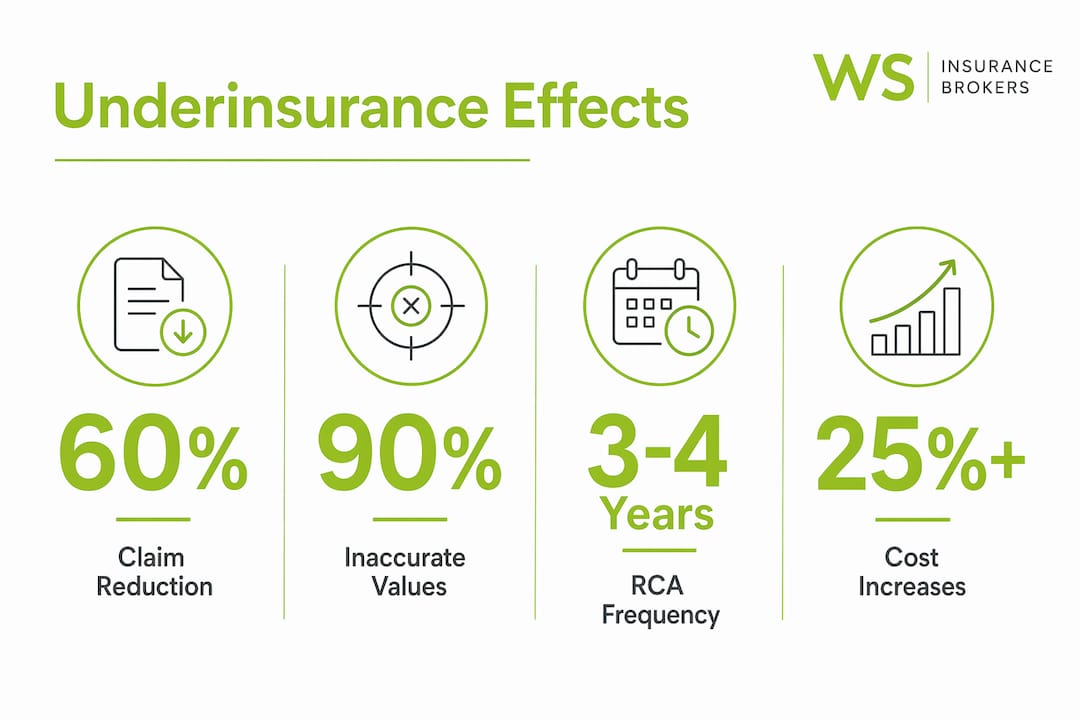
The calculation is straightforward. If your block is insured for £2 million but the true reinstatement value is £4 million, you are insured for 50% of the actual value. The average clause means the insurer will pay only 50% of any valid claim. A burst pipe causing £80,000 of damage results in a payout of just £40,000. You fund the remaining £40,000 yourself.
The consequences for freehold blocks are particularly serious because of the multi-party nature of ownership:
- Leaseholders face unexpected demands for service charge contributions to cover uninsured shortfalls.
- Managing agents face scrutiny and potential negligence claims if they arranged or renewed the policy without flagging the underinsurance risk.
- Freeholders carry the ultimate legal obligation under most leases to maintain adequate buildings insurance.
- RMCs and RTM companies may face directors’ liability if they failed to commission a professional reinstatement cost assessment (RCA).
The average clause applies even to minor partial losses, not only catastrophic events. A routine escape of water claim, the most common type of block insurance claim, can trigger it just as readily as a fire.
Pro Tip: Ask your insurer or broker explicitly whether the average clause applies to your policy and under what conditions. Some specialist block policies include an agreed value provision that removes or limits its application.
What causes underinsurance in freehold blocks?
Several factors combine to create and sustain underinsurance in freehold blocks. Understanding them helps you identify where your own exposure may lie.
Outdated declared values
Many freeholders inherit a declared value from a previous owner or managing agent. That figure may have been set years ago, based on a market valuation or a rough estimate. Without a professional RCA, there is no reliable basis for the sum insured.
The false comfort of index-linking
Annual index-linking adjusts the sum insured each year by a general construction cost index. It sounds reassuring. The problem is that index-linking adjusts an already incorrect figure. If the original declared value was wrong, index-linking simply compounds the error year after year. It does not correct the underlying gap. It also fails to account for property-specific factors such as unusual construction materials, listed building status, or site access constraints.
Contingent buildings insurance misconceptions
Some leaseholders and intermediate landlords hold contingent buildings insurance as a safety net. This cover only activates if the primary policy fails entirely. It cannot correct underinsurance, and it does not prevent the average clause from reducing a claim payout. Treating contingent cover as protection against underinsurance is a significant and common error.
Construction market volatility
| Factor | Effect on reinstatement cost |
|---|---|
| Timber and steel price rises | Increases material costs significantly |
| Labour shortages in construction | Pushes up contractor rates |
| Supply chain delays | Extends project timelines and total costs |
| Updated building regulations | Adds compliance costs to any reinstatement |
Market volatility means that declared values become outdated faster than most renewal cycles account for. A block insured in 2022 may now carry a declared value that is materially below current reinstatement costs, even if it has been index-linked each year.
How can freeholders and managers mitigate underinsurance?
Accurate cover is achievable. The steps below are practical and apply whether you manage a single block or a portfolio.
-
Commission a professional RCA. A reinstatement cost assessment carried out by a RICS-qualified surveyor is the only reliable way to establish the correct sum insured. Professional RCAs every 3–4 years are the industry standard recommendation. Flatinsurance works with in-house RICS Chartered Surveyors who provide this service alongside specialist block insurance, giving you both the valuation and the cover in one place.
-
Review the sum insured at every renewal. Do not simply accept the index-linked renewal figure. Ask your broker to confirm whether the declared value reflects current construction costs and whether a fresh RCA is due.
-
Check your lease obligations. Most leases require the freeholder to insure the building for its full reinstatement value. Failure to do so is a breach of covenant, not just an insurance oversight. Review the insurance clause in your lease annually.
-
Communicate with leaseholders. Leaseholders pay the insurance premium through service charges. They have a legitimate interest in knowing the basis on which the sum insured is set. Transparent communication reduces the risk of disputes after a claim.
-
Use a specialist block insurance broker. A general insurance broker may not understand the specific valuation requirements for residential blocks. Specialist brokers with block-only expertise are better placed to identify underinsurance risks and recommend appropriate cover. You can find detailed guidance on block insurance for freeholders to understand what adequate cover looks like in practice.
Pro Tip: If you are a managing agent, document every conversation with the freeholder about reinstatement values and RCAs. This record protects you if a claim shortfall later leads to a negligence allegation.
What are the consequences of continuing underinsurance?
The financial and legal consequences of underinsurance in freehold blocks extend well beyond a reduced claim payout. Freeholders and managers who allow underinsurance to persist face a range of compounding problems:
- Claim shortfalls. The average clause reduces every payout, meaning the freeholder or service charge fund must cover the gap. For a major loss, this can run into hundreds of thousands of pounds.
- Leaseholder disputes. When leaseholders discover their building was underinsured, they frequently challenge the managing agent or freeholder. Disputes can escalate to the First-tier Tribunal (Property Chamber).
- Reinstatement delays. Insufficient insurance funds slow down repair work. Residents may be displaced for longer than necessary, creating further liability.
- Rental income loss. If the block includes buy-to-let units, delayed reinstatement directly reduces rental income. Loss of rent cover within the policy may also be insufficient if the sum insured is too low.
- Reputational damage. Managing agents who oversee underinsured blocks risk losing management contracts and professional indemnity cover. The financial and operational impacts affect all stakeholders, not just the freeholder.
Understanding the critical insights on underinsurance specific to blocks of flats helps freeholders and managers recognise these risks before a claim forces the issue.
Key takeaways
Freehold block underinsurance is defined by the gap between the insured sum and the true reinstatement cost, and that gap triggers the average clause on every claim, regardless of its size.
| Point | Details |
|---|---|
| Reinstatement cost, not market value | Always base the sum insured on a professional reinstatement cost assessment, not the purchase price or market valuation. |
| Average clause applies to all claims | Even a small escape of water claim is reduced proportionally if the block is underinsured. |
| Index-linking does not fix errors | Annual index-linking compounds an incorrect declared value rather than correcting it. |
| RCA every 3–4 years | A RICS reinstatement cost assessment on this cycle is the industry standard for maintaining accurate cover. |
| Contingent cover is not a solution | Contingent buildings insurance only activates if the primary policy fails; it cannot prevent underinsurance shortfalls. |
The valuation problem nobody wants to talk about
Working in block insurance, the pattern I see most often is not ignorance. It is inertia. Freeholders and managing agents know, on some level, that their declared value might be wrong. They just do not act on it because the consequences feel abstract until a claim arrives.
The BCH finding that 90% of buildings carried inaccurate declared values before professional appraisal did not surprise me. What surprises me is how many people read that figure and still do not commission an RCA. The assumption seems to be that index-linking is “close enough.” It is not. Index-linking is a maintenance tool for an accurate figure, not a substitute for one.
The other misconception I encounter regularly is around contingent buildings insurance. Leaseholders and intermediate landlords sometimes believe this cover protects them against the freeholder’s underinsurance. It does not. It is a last-resort measure for policy failure, not a correction for an inadequate sum insured.
My honest recommendation: treat the RCA as a non-negotiable part of your insurance cycle, not an optional extra. The cost of a professional assessment is trivial compared to the shortfall you will face if a major claim hits an underinsured block. Proactive management and clear communication with leaseholders about how the sum insured is set will save you far more than it costs.
— Thomas
Specialist block insurance cover from Flatinsurance
Freehold block underinsurance is a preventable risk, and Flatinsurance is built specifically to help you prevent it.

As a specialist block insurance brokerage backed by in-house RICS Chartered Surveyors, Flatinsurance provides professional reinstatement cost assessments alongside tailored block insurance policies. This means you get an accurate declared value and the right cover in one place, without having to coordinate between separate advisers. Whether you manage a single freehold block or a large portfolio, Flatinsurance can arrange a specialist block insurance quote that reflects the true reinstatement cost of your building. Speak to the team today to review your current declared value and confirm your cover is fit for purpose in 2026.
FAQ
What is freehold block insurance?
Freehold block insurance is a buildings insurance policy arranged by the freeholder to cover the full reinstatement cost of a residential block, including shared areas, structure, and fixtures. It typically includes property owners’ liability and loss of rent cover.
How does the average clause affect a freehold block claim?
The average clause reduces any claim payout in proportion to the degree of underinsurance. If a block is insured for half its true reinstatement value, the insurer pays only half of every valid claim, including partial losses.
How often should a reinstatement cost assessment be carried out?
A professional RCA every 3–4 years is the industry standard recommendation, with index-linking applied in the intervening years to an already accurate base figure.
Does contingent buildings insurance protect against underinsurance?
No. Contingent buildings insurance only activates if the primary policy fails entirely. It cannot correct an insufficient sum insured or prevent the average clause from reducing a claim payout.
What are the most common causes of underinsurance in freehold blocks?
The most common causes are reliance on market value instead of reinstatement cost, outdated declared values inherited from previous owners, and the mistaken belief that annual index-linking keeps the sum insured accurate.