
Property insurance premiums paid wholly and exclusively for a UK rental business are fully deductible revenue expenses against rental income. That is the core rule, and it applies whether you are an individual filing Self Assessment or a limited company paying Corporation Tax. The legal authority sits in the Income Tax (Trading and Other Income) Act 2005 (ITTOIA 2005), specifically section 34 for the “wholly and exclusively” test, applied to property businesses via section 272. HMRC’s Property Income Manual PIM2110 confirms the principle and lists the qualifying insurance categories.
Getting these deductions right is not just about saving tax. Misclassifying a premium, missing an apportionment, or confusing a revenue expense with a capital one can trigger an HMRC enquiry, penalties, and interest. The categories that qualify as allowable expenses are:
- Buildings insurance (protecting the physical structure, including blocks of flats)
- Contents insurance (for furnished rental properties)
- Property owners’ liability insurance (covering injury or property damage claims)
- Rent guarantee insurance (protecting rental income when tenants default)
- Legal expenses insurance (solicitor and court costs for tenancy disputes)
- Malicious damage cover (less common but equally allowable)
All of these sit in the “Rent, rates, insurance, ground rents” box on the SA105 property pages for individuals, or within the expenses schedule of a company’s accounts. The same deduction rules apply across individuals, partnerships, and limited companies; the only difference is whether the relief flows through Income Tax or Corporation Tax.
Which property insurance expenses can landlords deduct?
Buildings insurance is the most straightforward deductible cost. It covers the physical structure against fire, flood, subsidence, and similar risks. For landlords of blocks of flats, the buildings premium typically covers the entire block, and the full premium is deductible where the property is wholly let. Where a freeholder insures a building that includes a residential element and a commercial element, only the proportion attributable to the letting business qualifies.

Contents insurance applies specifically to furnished lets. If you provide beds, sofas, white goods, or other furnishings, the premium protecting those items is an allowable expense. An unfurnished property has no contents to insure in this context, so the deduction simply does not arise.
Property owners’ liability insurance protects against claims from tenants, visitors, or third parties who suffer injury or property damage connected to your building. HMRC treats this as a straightforward business protection cost, and the full premium is deductible. You can read more about how this cover works in Flatinsurance’s guide to property owners’ liability.
Rent guarantee insurance is one landlords sometimes overlook at tax time. The premium is deductible, and separately, any payout you receive under the policy is taxable rental income (covered in detail in the payouts section below). Legal expenses insurance, covering solicitor fees and court costs for tenancy disputes, possession proceedings, or rent recovery, is equally allowable.
- Buildings insurance: full premium deductible for wholly let properties
- Contents insurance: deductible for furnished lets only
- Property owners’ liability: full premium deductible
- Rent guarantee insurance: premium deductible; payouts are taxable income
- Legal expenses insurance: deductible for tenancy-related cover
- Malicious damage cover: deductible as a property protection cost
Pro Tip: All of these insurance costs go into a single expenses box on SA105. Keep a separate schedule in your records showing the breakdown by policy type, so you can reconstruct the figure quickly if HMRC asks.
How the “wholly and exclusively” rule applies to your insurance premiums
The wholly and exclusively test is the gateway every expense must pass. Under ITTOIA 2005 section 34, an expense is only deductible if it is incurred wholly and exclusively for the purposes of the rental business. A premium that covers both your rental property and your own home in a single policy fails this test unless you apportion it.
A common misunderstanding is that any incidental personal benefit automatically disqualifies the deduction. HMRC’s own guidance clarifies that it is the dominant purpose that matters. If the primary reason for taking out the policy is to protect the rental business, incidental personal benefit does not block the deduction. The problem arises when the policy genuinely serves two purposes and no apportionment is made.
Apportionment must be fair and reasonable to ensure accurate tax reporting, as explained in Services | StappInsurance. HMRC accepts methods based on floor space proportions, sum insured proportions, or other logical bases that reflect the actual split between business and personal use. The HMRC Property Rental Toolkit identifies failure to apportion mixed-use policies as one of the most frequent audit triggers for landlords. Claiming the full premium on a policy that clearly covers personal risks is the kind of error that invites scrutiny.
- Policies covering only rental properties: fully deductible, no apportionment needed
- Policies covering both a rental property and a private residence: apportion by floor space or sum insured
- Policies with a dominant business purpose but incidental personal benefit: generally deductible in full
- Life insurance on a buy-to-let mortgage: not deductible, regardless of the business connection
Pro Tip: Document your apportionment method in writing at the time you claim it. A brief note in your records explaining the basis (e.g. “65% of floor space is let; 65% of premium claimed”) is far more persuasive to an HMRC officer than a figure with no supporting rationale.
One scenario worth flagging: a landlord who lives in one flat of a block they own and lets the remaining flats. The buildings insurance covers the whole block. The correct approach is to apportion the premium by the proportion of the building used for letting, and claim only that portion as a rental business expense.
Revenue vs capital expenses: why the distinction matters for insurance
Insurance premiums are revenue expenses, not capital ones. The distinction is not just accounting terminology; it determines whether the cost is deductible against rental income at all. Revenue expenses are recurring costs that maintain the property and protect the income stream without creating a new or improved asset. Capital expenses, by contrast, relate to improvements or additions that enhance the property’s value or extend its useful life.
An annual buildings insurance premium fits the revenue category precisely because it provides protection for a fixed period and creates no enduring asset. Pay it again next year and you get the same protection again. The HMRC Business Income Manual BIM37005 confirms this principle: insurance premiums are revenue expenses because they do not represent improvements to the property.
Where landlords sometimes go wrong is in treating a one-off premium for a specialist policy as capital expenditure. A structural warranty or latent defects insurance taken out on a new build, for example, may have characteristics closer to a capital cost depending on how it is structured. The test is always whether the expenditure creates or improves an asset, or simply protects what already exists.
- Revenue expenses (deductible): annual buildings insurance, contents insurance, liability cover, rent guarantee, legal expenses insurance
- Capital expenses (not deductible as revenue): structural warranties on new builds where the cost is part of the acquisition, certain one-off premiums that form part of the purchase price
Pro Tip: If you are unsure whether a specialist insurance product is revenue or capital, look at what it protects against. Annual protection of an existing asset is almost always revenue. A premium that forms part of the cost of acquiring or constructing a property is more likely capital.
Confusing the two has a knock-on effect on Capital Gains Tax. Capital expenditure that is not deductible as a revenue expense may qualify as an enhancement cost when you eventually sell the property, reducing your CGT liability. Claiming it incorrectly as a revenue expense not only risks an HMRC challenge but also removes a legitimate CGT relief you could have used later.
How insurance payouts affect your tax position
The tax treatment of an insurance payout depends entirely on what the payout is for. Getting this wrong is one of the most common sources of tax errors in rental accounts, according to HMRC’s PIM2110 guidance.
Payouts for property damage repairs are set against the cost of those repairs. If your insurer pays £8,000 to fix storm damage and the repair costs £8,000, the net tax effect is nil: the repair cost is a deductible expense, and the insurance recovery offsets it. Where the payout exceeds the repair cost, the excess is taxable income of the property business.
Payouts for lost rent are taxable rental income, full stop. If your rent guarantee policy pays out £6,000 because a tenant defaulted, that £6,000 goes into your rental income for the year. The premium you paid for the policy was already deducted as an expense, so the payout is the other side of that transaction.
- Damage repair payout: set against repair costs; net effect is nil unless payout exceeds cost
- Excess payout over repair cost: taxable as rental income
- Lost rent payout (rent guarantee, loss of rent cover): fully taxable as rental income
- Capital sum where property is not reinstated: may be subject to Capital Gains Tax, not Income Tax
- Personal insurance payout (e.g. life cover): neither deductible nor taxable within the rental business
The CGT scenario arises when a property is so badly damaged that it is not reinstated and the insurer pays a capital sum instead. In that case, the payout is treated as a disposal proceeds for CGT purposes, not rental income. This is a relatively rare situation but one where the tax treatment diverges sharply from the standard repair scenario.
What records do you need to support your insurance deductions?
Good record-keeping is what separates a clean HMRC enquiry from a painful one. The tax return itself shows only totals; the underlying records are what you need to defend those totals. Landlords must keep policy schedules, payment receipts, and any apportionment calculations, and these should be retained for at least five years after the filing deadline for the relevant tax year.
The timing of when you claim the expense also matters. Landlords on the cash basis deduct insurance premiums in the tax year they are paid. Those on the accrual basis must apportion premiums across the periods they cover. A premium paid in march for the year ahead, for instance, would be split between two tax years under the accrual basis. Making Tax Digital for Income Tax Self Assessment (MTD for ITSA), which applies to landlords with qualifying income from april 2026, requires quarterly digital updates, so your records need to be current and accessible throughout the year, not just at filing time.
- Policy schedules for every insurance product claimed
- Payment receipts or bank statements confirming the premium was paid
- Apportionment calculations with the method clearly noted
- Renewal notices showing the period of cover
- Correspondence with insurers relevant to any claims made
Pro Tip: Use a dedicated folder in your cloud storage or accounting software for each tax year, with subfolders per property. Label each document with the policy type and period of cover. When an HMRC enquiry arrives, you want to be able to produce the evidence within hours, not days.
Digital record-keeping aligned with MTD for ITSA is not just good practice; from april 2026 it becomes a compliance requirement for landlords with qualifying income above the relevant threshold. Accounting software that links directly to your bank account and categorises insurance payments automatically will save time and reduce the risk of missed or duplicated entries.
How Flatinsurance approaches insurance and tax for UK landlords
Flatinsurance is a specialist UK brokerage focused exclusively on blocks of flats insurance, serving residential management companies, right to manage companies, freeholders, managing agents, and portfolio landlords. That narrow focus matters when it comes to tax deductions, because the insurance structures for blocks of flats are more complex than those for a single buy-to-let property.
A block of flats typically involves a single buildings policy covering multiple units, sometimes with a mix of owner-occupied and let flats. The premium allocation between deductible rental business costs and non-deductible personal costs requires careful apportionment, and getting it wrong in either direction creates a tax problem. Flatinsurance’s in-house RICS Chartered Surveyors provide professional rebuild cost assessments, which directly affect the sum insured and therefore the premium. An accurate rebuild valuation means you are neither overpaying for cover (and claiming a larger deduction than necessary) nor underinsured (which creates a different set of financial risks entirely).
For portfolio landlords managing multiple blocks, the accountant property insurance cost advice available from Flatinsurance helps align insurance structures with tax reporting requirements from the outset. Policies arranged with clear schedules per property, per block, and per risk category make the accountant’s job straightforward and reduce the chance of errors on the tax return.
- Specialist block of flats policies with clear per-property premium schedules
- Rebuild cost assessments to support accurate sum insured and premium levels
- Expert guidance on policy structures that simplify tax apportionment
- Cover for RMCs, RTM companies, freeholders, and portfolio landlords
Pro Tip: Ask your insurer or broker to provide a premium breakdown by property or block when you hold a portfolio policy. A single lump-sum premium across multiple properties is harder to allocate correctly in your accounts and creates unnecessary work at tax time.
Working with a specialist broker who understands both the insurance and the property management context means the policies you buy are structured in a way that supports clean tax reporting. General brokers rarely think about how a policy schedule will read to an accountant or an HMRC officer.
How to claim property insurance deductions on your UK tax return
The process for claiming insurance deductions is straightforward once you know where the figures go and how to calculate them.
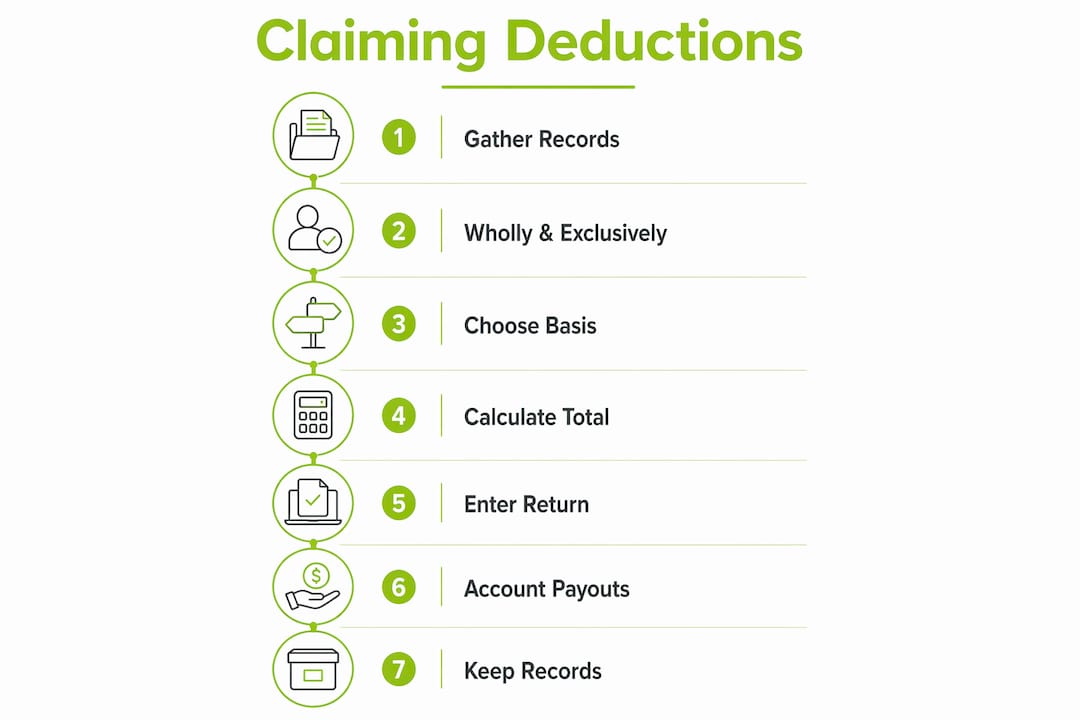
Step 1: Gather your insurance records. Collect policy schedules and payment receipts for every insurance product covering your rental properties. Note the period of cover for each policy.
Step 2: Apply the wholly and exclusively test. For each policy, confirm it relates solely to the rental business. If a policy covers both personal and rental risks, calculate your apportionment and record the method.
Step 3: Determine your accounting basis. If you use the cash basis, the deductible amount is what you paid in the tax year. If you use the accrual basis, apportion premiums across the periods they cover.
Step 4: Total your allowable insurance expenses. Add up the deductible portions of all qualifying premiums for the tax year.
Step 5: Enter the figure on your return. For individuals, insurance costs go into the “Rent, rates, insurance, ground rents” box on the SA105 property pages. For limited companies, they appear in the expenses schedule of the company accounts and CT600 return.
Step 6: Account for any insurance payouts. If you received a payout during the year, apply the correct tax treatment: offset damage repair payouts against repair costs, and include lost rent payouts as rental income.
Step 7: Retain your supporting records. File policy schedules, receipts, and apportionment notes for at least five years after the filing deadline. For MTD for ITSA purposes, keep digital records updated quarterly.
One practical point: if you pay your buildings insurance by monthly direct debit, the total annual premium is still the deductible figure, not twelve separate monthly amounts. The timing rules (cash vs accrual basis) determine which tax year the deduction falls in, but the amount is always the full premium for the period of cover.
What happens when insurance deductions go wrong?
Incorrect or missed insurance deductions carry real consequences, and HMRC’s compliance activity in the property income sector is active. The HMRC Property Rental Toolkit is used by tax agents and HMRC officers alike to identify the most common errors in rental accounts, and insurance expenses feature prominently.
Underclaiming is the most common error among landlords who self-file. Missing a qualifying premium, failing to claim a rent guarantee policy, or not realising that legal expenses insurance is deductible means paying more tax than you owe. HMRC will not correct this for you; the responsibility sits with the taxpayer.
Overclaiming carries more serious consequences. Claiming a personal life insurance premium, deducting the full cost of a mixed-use policy without apportionment, or treating a capital insurance cost as a revenue expense can all result in an HMRC enquiry. If HMRC opens an enquiry and finds errors, the outcomes range from a simple amendment and repayment of the overclaimed tax to formal penalties.
Penalties for inaccurate returns depend on whether the error is careless or deliberate. A careless error typically attracts a penalty of up to 30% of the unpaid tax, while a deliberate error can reach 70% or higher. Interest accrues on unpaid tax from the date it was due. The combination of penalties and interest on a multi-year error across a property portfolio can be substantial.
The best protection is accurate records and a clear understanding of the rules. If you are managing a complex portfolio, a block of flats, or a mix of personal and business properties, professional advice from a specialist accountant or broker is worth the cost many times over.
Key takeaways
UK landlords can deduct property insurance premiums wholly and exclusively incurred for their rental business as revenue expenses under ITTOIA 2005, provided they maintain accurate records and apply correct apportionment for any mixed-use policies.
| Point | Details |
|---|---|
| Wholly and exclusively rule | Only premiums incurred solely for the rental business qualify; mixed-use policies must be apportioned fairly. |
| Deductible insurance types | Buildings, contents (furnished lets), property owners’ liability, rent guarantee, and legal expenses insurance all qualify. |
| Revenue vs capital distinction | Annual insurance premiums are revenue expenses; one-off premiums forming part of a property acquisition may be capital. |
| Tax treatment of payouts | Damage repair payouts offset repair costs; lost rent payouts are taxable rental income. |
| Record-keeping requirement | Keep policy schedules, receipts, and apportionment notes for at least five years after the relevant filing deadline. |
Get specialist block of flats insurance advice from Flatinsurance

If you manage a block of flats, a portfolio of buy-to-let properties, or a residential management company, the insurance structures you put in place directly affect your tax position. Flatinsurance specialises exclusively in block of flats insurance, providing tailored policies, professional rebuild cost assessments, and clear premium schedules that make tax reporting straightforward for you and your accountant.
Speak to the Flatinsurance team today for a free quote and specialist advice on structuring your cover correctly.